Author: Karen Skibba

  • UW–Madison’s Skibba, Widmer receive Robert J. Menges Research Award

    The Division of Continuing Studies’ Karen Skibba and the School of Education’s Maria Widmer have been honored with the Robert J. Menges Award for Outstanding Research in Educational Development from the Professional and Organizational Development (POD) Network.

    The Menges Award honors sessions by POD Network members who focus on original, transformative research characterized by rigorous, systematic investigation and evidence-based conclusions.

    Skibba and Widmer received the Menges Award for the research conducted in their upcoming chapter in “Blended Learning Research Perspectives, Vol. 3” presented during a November 2020 POD conference session that was titled, “Faculty Community of Inquiry Transforms Online Teaching Perceptions and Practices.” This research study analyzes the impact of the TeachOnline@UW blended learning community on participants’ perceptions of and practices for online education.

    Learn more about the POD Network’s awards and fellowships, here.

    Following is the book chapter abstract and recording of the Skibba and Widmer Menges Award winning session presented at the Professional & Organizational Development Conference that took place November 11-13, 2020.

    The book chapter draws on the Community of Inquiry (CoI) framework to analyze the impacts of a blended learning community on participants’ perceptions of and practices for online education. Using surveys, thematic content analysis, and instructor interviews, this case study finds that the multi-modal blended program design and holistic student learning experience were impactful. Direct experience as students in a program that models social presence, teaching presence, and cognitive presence most influenced instructor participants’ course design and teaching beliefs and practices. Practical techniques and applications of the CoI framework in professional development provide evidence-based strategies to guide instructors through teaching transformation.

    Video Summary: This POD conference session presented faculty development strategies to transform instructors’ perceptions and practices of online course design and teaching.
  • D2L Conference Presentation – TeachOnline@UW: Creating a Faculty Community of Inquiry

    Following is the abstract and recording of a session presented at the DTL Conference that took place August 7, 2019.


    A cross-campus committee of instructional designers from the University of Wisconsin-Madison developed a two-semester collaborative faculty learning community called “TeachOnline@UW.”

    To support the exploration and application of best practices in online course design and facilitation, learning community facilitators made strategic use of the Community of Inquiry theoretical framework (Garrison, Anderson, & Archer, 2011). This framework represents a process for creating collaborative-constructivist learning experiences through the development of three interdependent elements: social, cognitive, and teaching presence. While the Community of Inquiry framework was initially presented within the context of online learning experiences, the three dimensions of presence that are foundational to the framework can be used to establish a successful faculty learning community.

    Social presence strategies used in the faculty learning community include face-to-face and online discussions. Program facilitators establish teaching presence through the “design, facilitation, and direction” of participants’ experiences (Anderson, Rourke, Garrison, & Archer, 2011). Cognitive presence is established through learning activities that promote reflection, discussion, and application.

    About the Presenters

    • Karen Skibba, PhD, is an Online Faculty Development Program Manager for Educational Innovation Program Development in the Division of Continuing Studies at the University of Wisconsin-Madison. As project manager of a faculty learning community called TeachOnline@UW, she is responsible for helping instructors learn how to design and teach quality online courses.
    • Jonathan Klein is an Instructional Design and Technology Consultant for University of Wisconsin-Madison’s College of Letters and Science where he leads online course design and production services.
    • Maria Widmer is an Instructional Designer for the University of Wisconsin-Madison School of Education.
  • 2019 PARTICIPANTS AND ALUMNI

    Recent TeachOnline@UW graduates and alumni shared insights about the program and online course design and teaching at the culmination celebration held May 23, 2019. In addition, program descriptions and summaries were provided along with campus updates by campus leaders.

    Read the summary, watch the full video, or click on the segments below (The video segments start and each noted section but will continue to play unless you stop the video).


  • Video Overview of TeachOnline@UW Program

    Review this brief video overview of the TeachOnline@UW program and highlights of the two main courses: “Plan & Design” and “Facilitation & Management.” Participant perspectives are also provided (a summary of participant reflections provided on the Feedback & Reflections Page.

  • Instructors apply online best practices through TeachOnline@UW

    Open to UW-Madison faculty and instructional staff, this free program prepares participants to design and teach rigorous online courses. Apply by July 31 for the fall course on planning and designing an online course. The spring course centers on course facilitation and management.

    Read the full article at: https://news.continuingstudies.wisc.edu/instructors-apply-online-best-practices-through-teachonlineuw/


  • 2018 Participants and Alumni Reflect on TeachOnline@UW

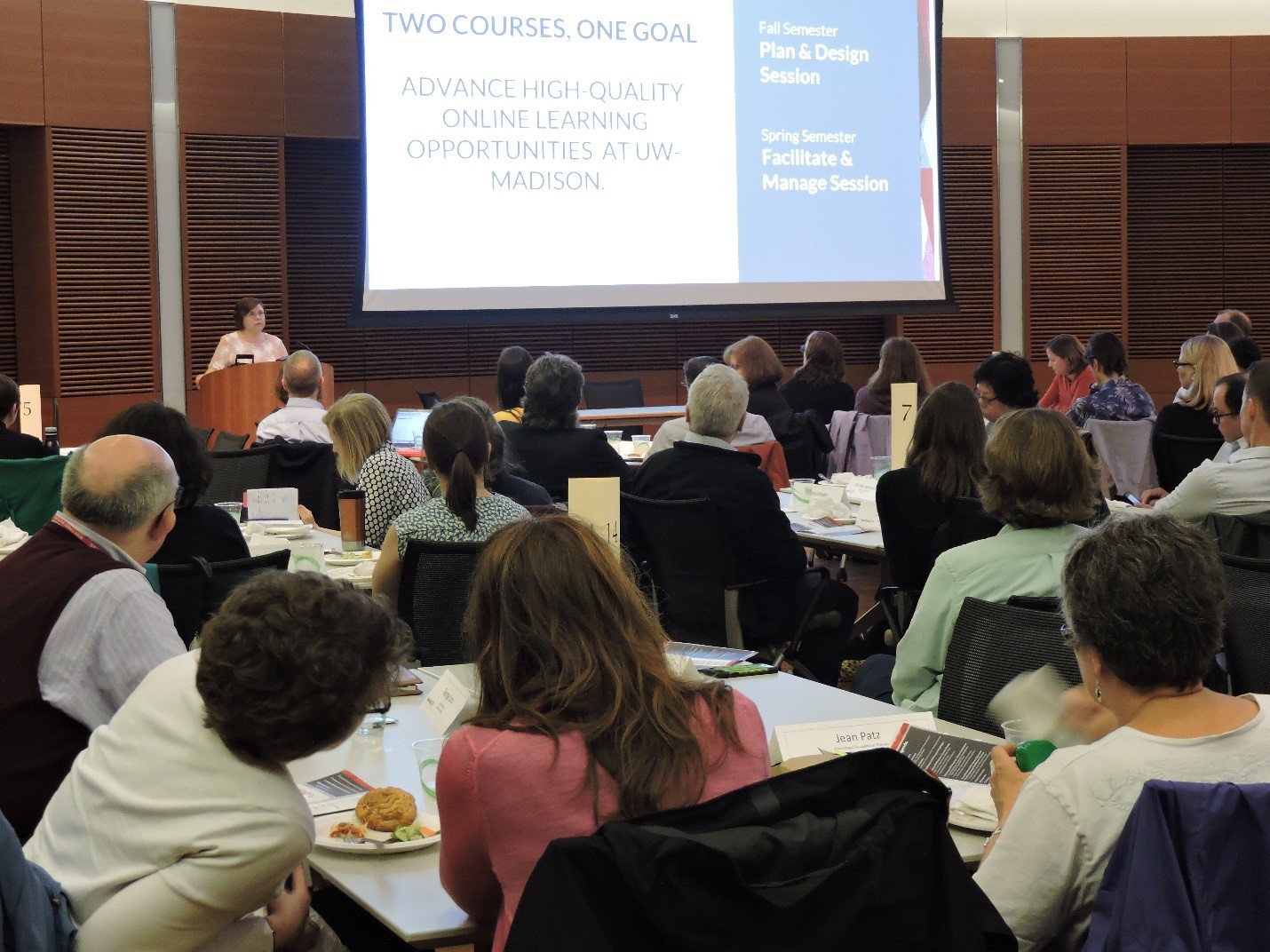
    Recent TeachOnline@UW graduates and alumni shared insights about the program and online course design and teaching at the culmination celebration held May 9, 2018. In addition, program descriptions and summaries were provided along with campus updates by campus leaders.

    Read the summary, watch the full video, or click on the segments below (The video segments start and each noted section but will continue to play unless you stop the video).

  • A successful year for TeachOnline@UW

    TeachOnline@UW just finished its fourth year of helping UW-Madison instructors design and teach fully online courses.  A May 9 culmination event celebrated the success of the 41 instructors who completed the program this year. Six recent graduates of the program shared how the experience has helped them enhance their online teaching, and two alumni from the first cohort explained how they’ve applied what they learned to high-enrollment online courses.

    Tim Paustian, a Department of Bacteriology instructor who just completed TeachOnline@UW, called it a “transformative experience” that showed him the importance of building community in online courses.

    “The methods I was taught in TeachOnline@UW make it much more likely that I’ll create a community that increases student participation,” Paustian said, “and I feel much more confident about going into my first online teaching experience.”

    Karen Skibba, project manager of TeachOnline@UW, discusses the program’s goals at a May 9 culmination event that attracted about 100 attendees. She said instructors devote significant time improving their courses during the program, demonstrating their “commitment to teaching quality online courses.”

    Heather Kirkorian, an associate professor teaching high-enrollment courses in the School of Human Ecology, noted that careful planning goes a long way in online courses. She also shared a tip she received in TeachOnline@UW: Be strategic with time-intensive activities like manually grading papers.

    “One-paragraph discussion prompts can help students connect what we’re talking about to current events, a big issue in the world, or something in their own experiences,” Kirkorian said. “I’ve been really, really impressed with what our students will do in a 200-word discussion post with a well-constructed prompt, things I think I’ve never seen them do in a five-page research paper.”

    Since its inception, 135 faculty and instructors have completed TeachOnline@UW, which combines online courses with discussions about implementing research-based best practices for course design and teaching. The program has two courses that put instructors in the role of the online students they teach. The first focuses on planning and designing an online course, while the second centers on course facilitation and management. Participants may complete one or both courses.

    The aforementioned discussions, which take place face-to-face or via webinar after each module of the courses, include participants’ colleagues and facilitators who are instructional design experts. They are a supportive place to work through challenges associated with online teaching and learning; they are also a space to share strategies and success stories.

    In a recent survey, 100% of TeachOnline@UW participants indicated that they were satisfied with the program. They have used their new knowledge in leading more than 300 online courses for approximately 14,000 students. Participants experience what it is like to be online learners as their facilitators model the best practices they’re studying.

    Participants also benefit from the community TeachOnline@UW builds across campus. Instructors from 14 schools and colleges and 71 departments have completed the program, which fosters cross-campus dialogue and collaboration.

    TeachOnline@UW is free, and many participants receive a stipend for participating ($750 for completing one course, $1,500 for completing both). Spots are still open in the fall Plan & Design course. If you know instructors who might be interested in this opportunity, encourage them to apply by July 31.

    For more information about TeachOnline@UW, contact program manager Karen Skibba at karen.skibba@wisc.edu.